More charge points despite limited connection capacity: optimal utilization through intelligent load management
More charge points do not automatically mean more grid connection capacity is needed. Intelligent load management and real smart charging make it possible to distribute available power precisely, prioritize charging demand and significantly improve utilization of the charging infrastructure.
:quality(80))
When grid connection capacity becomes the bottleneck
As the number of electric vehicles grows, so does the need for charge points. For companies, business parks, hotels or larger properties, this quickly creates a challenge: the available grid connection capacity is limited.
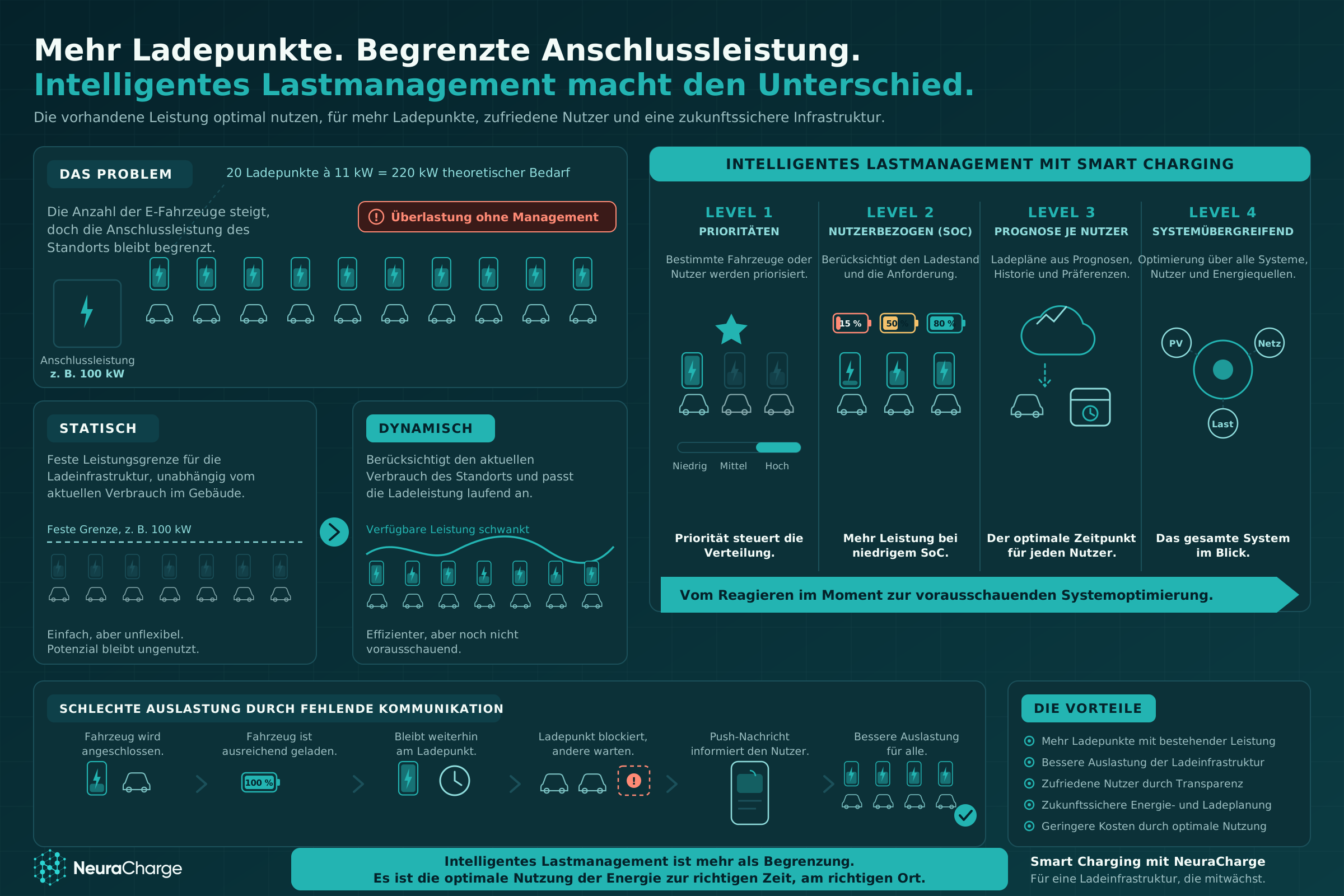
An example: if 20 charge points are installed at 11 kW each, the theoretical power demand is 220 kW. In practice, that additional capacity is often not available at the site. At the same time, buildings, production, heat pumps and other loads also need energy. Increasing the connection capacity is not always economically or technically feasible. Distributing the available capacity intelligently therefore becomes crucial.
Static load management
With static load management, a fixed maximum power level is defined for the charging infrastructure.
If 100 kW is available, for example, the entire charging infrastructure must not exceed that limit. The power is distributed across the active charge points.
The drawback: the site's actual consumption is not taken into account. If the building currently needs considerably less power, that free capacity cannot automatically be used for charging.
The system does protect against overload, but it does not make optimal use of the available resources.
Dynamic load management
Dynamic load management goes a step further. It takes the site's current energy consumption into account. If building consumption falls, more power automatically becomes available for the charging infrastructure. If consumption rises, charging power is reduced accordingly. This allows the available connection capacity to be used far more efficiently. One decisive question remains open, however:
Which vehicle should receive how much of the available power?
This is where real Smart Charging begins.
Level 1: Priorities
At the first level, vehicles, charge points or users are prioritized differently. A vehicle that will be needed again shortly can receive more charging power than one that will remain on site for several more hours. Instead of simply distributing power evenly, the system decides which charging demand is more important.
Level 2: User-based control with state of charge
The next step takes the vehicle's current state of charge into account. A vehicle at 15 percent state of charge can, for example, be prioritized over one already at 80 percent.
Individual requirements can also be factored in, for example:
desired departure time
required amount of energy
charging priority
individual charging preferences
Power distribution is then no longer controlled purely technically, but on a per-user basis.
Level 3: Forecasting and optimization for individual users
Real smart charging does not react solely to the current state. It also takes into account what is likely to happen over the next few hours. Historical data, charging behavior, PV production, available capacity and user requirements can all be used to create individual charging plans. As a result, a vehicle does not have to be charged at maximum power immediately. If it will be on site for several more hours, the charging session can be shifted into a period with higher PV production or lower site load, for example.
The system therefore answers not only the question of who should charge, but also when the optimal charging time is.
Level 4: Cross-system optimization
At the highest level, the focus is no longer on a single user or charge point. Instead, different systems and data are optimized together, for example:
grid and connection capacity
building consumption
PV production
charging infrastructure
vehicle state of charge
expected departure times
user requirements
historical consumption data
The goal is holistic optimization of the site. Simple load management thus becomes intelligent control of energy, vehicles and users.
Another bottleneck: blocked charge points
It is not only connection capacity that can limit charging infrastructure. Poor utilization of existing charge points is also a problem at many companies. A typical example: a vehicle is plugged in during the morning and is sufficiently charged after a few hours. Even so, it stays at the charge point until the end of the working day. For other users the charge point is blocked, even though no further energy is actually needed.
Push notifications improve utilization
This is where communication with the user becomes decisive. An intelligent CPMS can detect when a vehicle is sufficiently charged or a charge point is no longer actively needed. Via push notifications, the user can be informed, for example:
Your vehicle has reached the desired charge level. Please free up the charge point for other users.
This allows existing charging infrastructure to be used better, without having to install additional charge points straight away.
Operating more charge points with the existing connection capacity
The decisive question is therefore not whether every charge point can draw its maximum power at any time. What matters is whether the available power is distributed intelligently.
The development runs from:
Static load management → dynamic load management → prioritization → SoC-based control → individual forecasting → cross-system optimization
Smart charging connects charging infrastructure, energy supply and users into a single system.
Smart Charging with NeuraCharge
NeuraCharge combines dynamic load management with user-based smart charging. State of charge, available connection capacity, PV production, historical data and individual charging preferences can all be taken into account in order to distribute charging power precisely and create individual charging plans. Through forecasting and optimization algorithms, charging infrastructure is controlled not just reactively, but predictively. At the same time, push notifications can actively involve users and help make blocked charge points available again more quickly.
This makes it possible to use existing connection capacity more efficiently, increase utilization of the charging infrastructure and intelligently supply a larger number of electric vehicles.
:quality(80))
:quality(80))