MID, calibration law & CPMS: what do I need to bill?
Anyone operating charging infrastructure quickly realizes that measuring electricity is one thing and billing it correctly is another. At the latest when employees, tenants, guests or company cars all charge via the same infrastructure, the question arises: which meter do I actually need? Is a simple energy meter enough? Do I need MID? And when does calibration law come into play?
But even with the right meter, the job is not done. The recorded charging data still has to be assigned to users, evaluated, billed and, where necessary, transferred to ERP, accounting or payroll systems.
That is exactly where a Charge Point Management System, or CPMS for short, comes in.
:quality(80))
Anyone operating charging infrastructure sooner or later faces the question: how can charging sessions be recorded and billed correctly? Is a simple electricity meter enough, do you need an MID meter, or does the charging station have to be calibration-law compliant? And what happens to the measurement data afterwards?
What types of electricity meter are used with charging stations?
In practice, three variants come up with charging infrastructure:
Simple energy meter:
A simple meter records how many kilowatt-hours were charged via the charging station. For private applications or a pure consumption overview, that may already be sufficient.
As soon as charging costs have to be billed or reimbursed between different parties, however, the requirements increase.
MID-compliant meter:
MID stands for “Measuring Instruments Directive”. An MID-compliant meter meets European requirements for measuring devices and enables a traceable record of the electricity charged.
That is particularly relevant for companies – for example when employees charge their company car at home and are to be reimbursed by their employer for the charging costs incurred.
Metering and calibration-law compliant charging station:
Depending on the country and the billing model, different metering and calibration-law requirements apply. One decisive factor is whether measured values are merely documented or used for consumption-based billing to third parties.
Which variant you need therefore always depends on the country and the specific use case.
The meter alone does not solve billing
Take a company with 20 charge points.
Some employees charge their company vehicles, others their private car. On top of that, guests and suppliers should be able to charge. Some employees also charge their company car at home.
The charging stations do record the kilowatt-hours consumed. But that raises further questions:
Who charged?
Was it a private or a business charging session?
Which electricity price has to be applied? Does the amount have to be billed or reimbursed?
How does the data then reach accounting or payroll?
These are exactly the tasks a CPMS takes over.
From measured value to automated billing
A CPMS connects the individual charging stations to the commercial processes behind them.
Every charging session is recorded centrally and assigned to the corresponding user, vehicle or cost center.
This makes it possible, for example, to:
reimburse company-car charging automatically
bill employees' private charging sessions
assign cost centers automatically
bill tenants monthly
let guests charge and pay without prior registration
generate reports automatically
hand charging data over to ERP and payroll systems
Individual charging records thus become an automated process.
Example: charging a company car at home
The advantage is particularly clear with company vehicles. An employee receives an electric company car and charges it mostly at home. The electricity costs incurred are to be covered by the company.
Instead of exchanging meter readings, spreadsheets or receipts every month, the entire process can be automated.
The charging station transmits the charging data to the CPMS. The relevant tariff is stored and the charging costs incurred are automatically assigned to the employee.
Via interfaces to ERP systems such as SAP or BMD, this data can then be provided directly for further billing or payroll.
At a company with 20 employees, payroll would normally have to transfer each employee's charged volume, including the relevant data, into the respective ERP system manually.
With a CPMS, this data is prepared automatically and summarized monthly in a cumulative list that can be imported into the ERP system at the push of a button.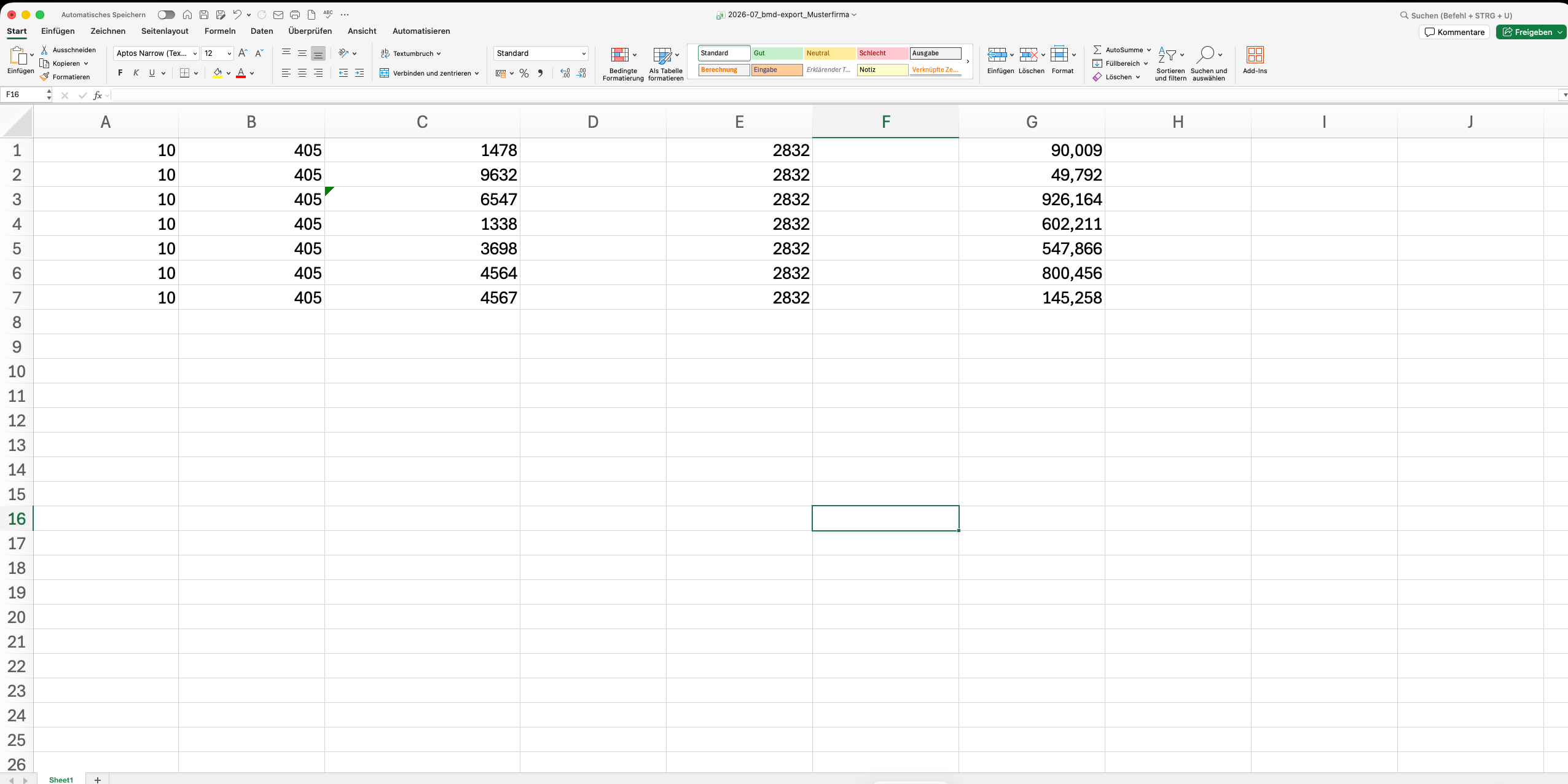 Column A: Payout month
Column B: Company number
Column C: Employee number
Column E: Cost center
Column G: Number of kWh
One site, different users
It gets even more interesting with shared charging infrastructure. A charge point in a company car park can be used by a company vehicle in the morning, by an employee with a private car in the afternoon and by a visitor later on. Technically it is always the same charging station.
Commercially, these are three completely different charging sessions.
The CPMS recognizes the respective user and automatically applies the conditions and processes intended for them. This means a separate charging infrastructure does not have to be built for every user group.
Existing charging infrastructure can be integrated too
Another important point: companies do not necessarily have to source their charging infrastructure from a single manufacturer. A manufacturer-independent CPMS can manage different compatible charging stations centrally. That is particularly interesting for companies and properties where charging infrastructure has grown over several years, or where different manufacturers are used at different sites. Instead of running several portals and billing systems in parallel, the relevant charging data comes together in one place.
From cost factor to business model
Charging infrastructure also does not have to be purely a cost factor.
Companies, hotels or property operators can also make their charge points available to employees, tenants, guests or visitors, and offer charging electricity on terms they define themselves.
The CPMS handles the technical management and billing.
An investment in charging infrastructure thus becomes infrastructure that not only generates costs, but can also be actively used and monetized.
So which solution do I need?
The decisive question is not only:
Which electricity meter do I need?
But rather:
What do I want to do with my charging data?
Anyone who simply wants to see their own consumption needs a different solution than a company that has to assign hundreds of charging sessions to different employees, cost centers or tenants.
The energy meter supplies the measured values. The CPMS turns them into an automated process.
Conclusion:
Professional charging infrastructure today no longer consists of just a charging station and an electricity meter.
As soon as several users, vehicles, sites or billing models come into play, the software behind it becomes the decisive component.
With NeuraCharge, different charge points can be managed centrally, charging sessions assigned automatically and billing processes largely automated.
Charging infrastructure thus becomes a scalable system that integrates into existing company processes.
Would you like to know which meters, charging stations and billing processes make sense for your use case?
We will analyze your existing or planned charging infrastructure together and show you how billing can be automated with NeuraCharge.
:quality(80))
:quality(80))