EV charging at hotels: how to bill your guests correctly
More and more guests arrive by electric car and expect to be able to charge at the hotel. But how do you bill for charging fairly, in a legally compliant way and without extra work at reception? This article shows the permitted billing models in Austria, the legal ground rules and a concrete worked example.
:quality(80))
Why billing becomes a cost issue
Many hotels introduced their first wallboxes as a free service. With two or three electric cars a month, that was a pleasant extra with no noticeable cost. Today the picture is different: the number of electric cars is growing, batteries are getting bigger, and a single full charge can amount to 50 to 70 kWh. At an electricity cost of €0.25 net per kWh, that is up to €17.50 per guest and night missing from the operating result with nothing in return.
On top of that comes an organisational problem: without a billing system, nobody at reception knows which guest charged how much. Anyone who wants to charge guests for electricity therefore needs a clear model and a solution that records charging sessions automatically.
These billing models are permitted in Austria
In its checklist for tourism businesses, the Austrian Economic Chamber (WKO) states that you may bill charging electricity by time, as a flat fee or by kilowatt hours consumed.
In practice, four variants have become established:
Included: Charging is included in the room rate or free of charge. This is simple and a strong marketing argument, but electricity costs grow unchecked with every additional electric car.
Flat fee: Guests pay a fixed amount per night or per charging session. No calibrated meter is required. The downside: someone topping up 5 kWh pays the same as someone charging 60 kWh.
Time-based tariff: Billing is per hour. Because vehicles charge at different speeds, two guests receive very different amounts of energy for the same time. For overnight guests who stay plugged in all night, the model makes little sense. Particularly in combination with load management, this can put guests at a disadvantage.
Per kWh: Every guest pays for exactly the energy they charged. This is the fairest and most transparent model. It requires a charging tariff device that complies with calibration law, i.e. hardware that meets the requirements of the Austrian calibration regulations for charging equipment.
You can read more about the technical requirements for metering in our article MID, calibration law and CPMS.
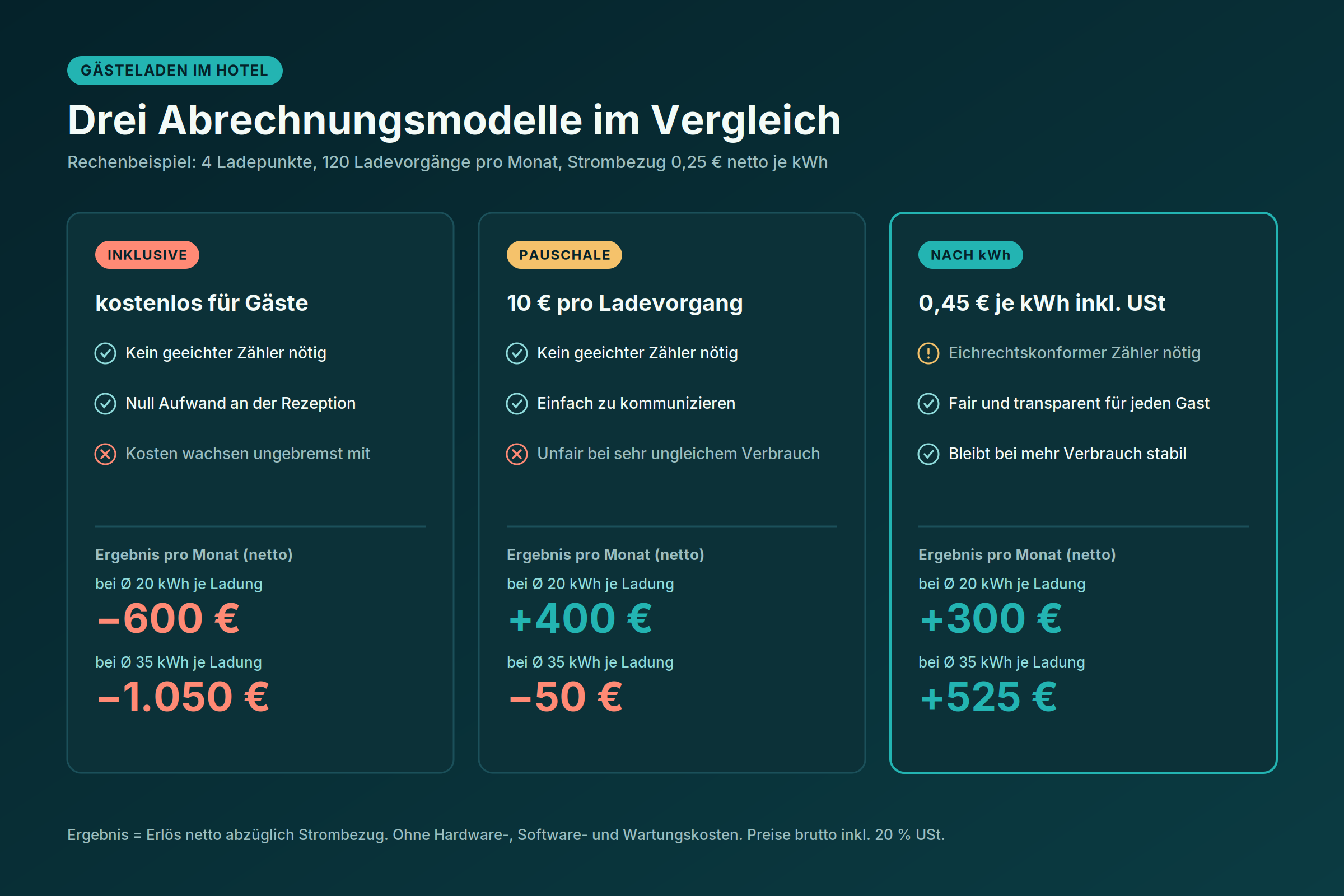
Worked example: what does guest charging really cost?
A hotel operates four charge points with a total of 120 charging sessions per month. Electricity costs €0.25 net per kWh to purchase. Three models are compared: free of charge, a flat fee of €10 gross per session and a price of €0.45 gross per kWh. All results are net, i.e. after deducting 20% VAT, and exclude hardware, software and maintenance costs.
Model | Avg. 20 kWh per session | Avg. 35 kWh per session |
|---|---|---|
Electricity cost (net) | €600 | €1,050 |
Included | -€600 | -€1,050 |
Flat fee €10 | €400 | -€50 |
€0.45 per kWh | €300 | €525 |
The example shows the crucial point: a flat fee can look good for small charging sessions, but turns into a loss as soon as guests arrive with large batteries. The kWh price, by contrast, grows automatically with consumption. Your result stays predictable, whichever vehicle is at the wallbox.
The legal ground rules at a glance
Trade law
According to the WKO, operating a charging station does not make you an electricity supplier but an end customer. Operating a charging station is an unregulated trade. Under Section 32 of the Austrian Trade Act (GewO), a hotel does not need a separate trade licence, as long as charging is an economically sensible addition to the hotel service and does not exceed 30% of total turnover.
Price information
Even if only hotel guests may charge, you must state prices clearly and as gross prices before the charging session begins. The WKO cites Section 22 of the Austrian Services Act (Dienstleistungsgesetz) as the legal basis. It is sufficient if the information is easily accessible at the charge point, via a QR code or on your website.
Calibration law
As soon as you bill per kWh, the measuring device must comply with calibration law. This obligation does not apply to a flat fee or a time-based tariff. Before switching to a kWh tariff, check whether your existing wallboxes meet the requirements.
VAT
In Austria, accommodation itself and the ancillary services regularly associated with it are subject to the reduced VAT rate of 10%. Charging electricity is generally not one of them and is therefore taxed at 20%. If charging is part of a package, the corresponding share must be separated out. Clarify the classification for your hotel with your tax adviser.
AFIR
The EU regulation AFIR applies to publicly accessible charge points. Charge points that are clearly signposted as reserved for hotel guests are generally not considered publicly accessible. If day visitors, restaurant guests or passing travellers can also charge, however, the AFIR obligations apply, such as ad hoc payment and price information. You can find details in our article Ad hoc charging and AFIR.
What matters in day-to-day hotel operations
A billing model is only as good as its implementation. Look out for these points when choosing your solution:
Clear assignment: Every charging session must be assignable to a guest, for example via a charging card from reception, a QR code or an app.
Different tariffs: Guests, employees and external visitors often need different prices.
Load management: In the evening, many guests arrive and plug in at the same time. Smart load management distributes the available power so that the building's grid connection is not overloaded. More on this in Limited grid connection capacity.
Clean records: For accounting, you need traceable reports showing energy, price and VAT for each charging session.
Guest charging with NeuraCharge
NeuraCharge is a manufacturer-independent platform for managing and billing charging infrastructure. You can continue to use existing wallboxes that support communication and add new charge points flexibly. Charging sessions are recorded and billed automatically, with a separate tariff for guests, employees and external users. Integrated load management ensures that all vehicles are charged by departure without overloading the grid connection. This turns the charging station from a cost factor into a service that pays for itself.
Would you like to know which model suits your hotel? Book a free, no-obligation consultation now.
Legal notice: This article provides a general overview of the legal situation in Austria (as of October 2026) and does not replace individual legal or tax advice.
:quality(80))