Employee charging in groups of companies: 7 companies, 3 sites, one billing process
When several companies buy electricity and employees charge at every site, billing quickly becomes a nightmare. A real-world example shows how NeuraCharge automatically assigns every charging session to employee, cost centre and company.
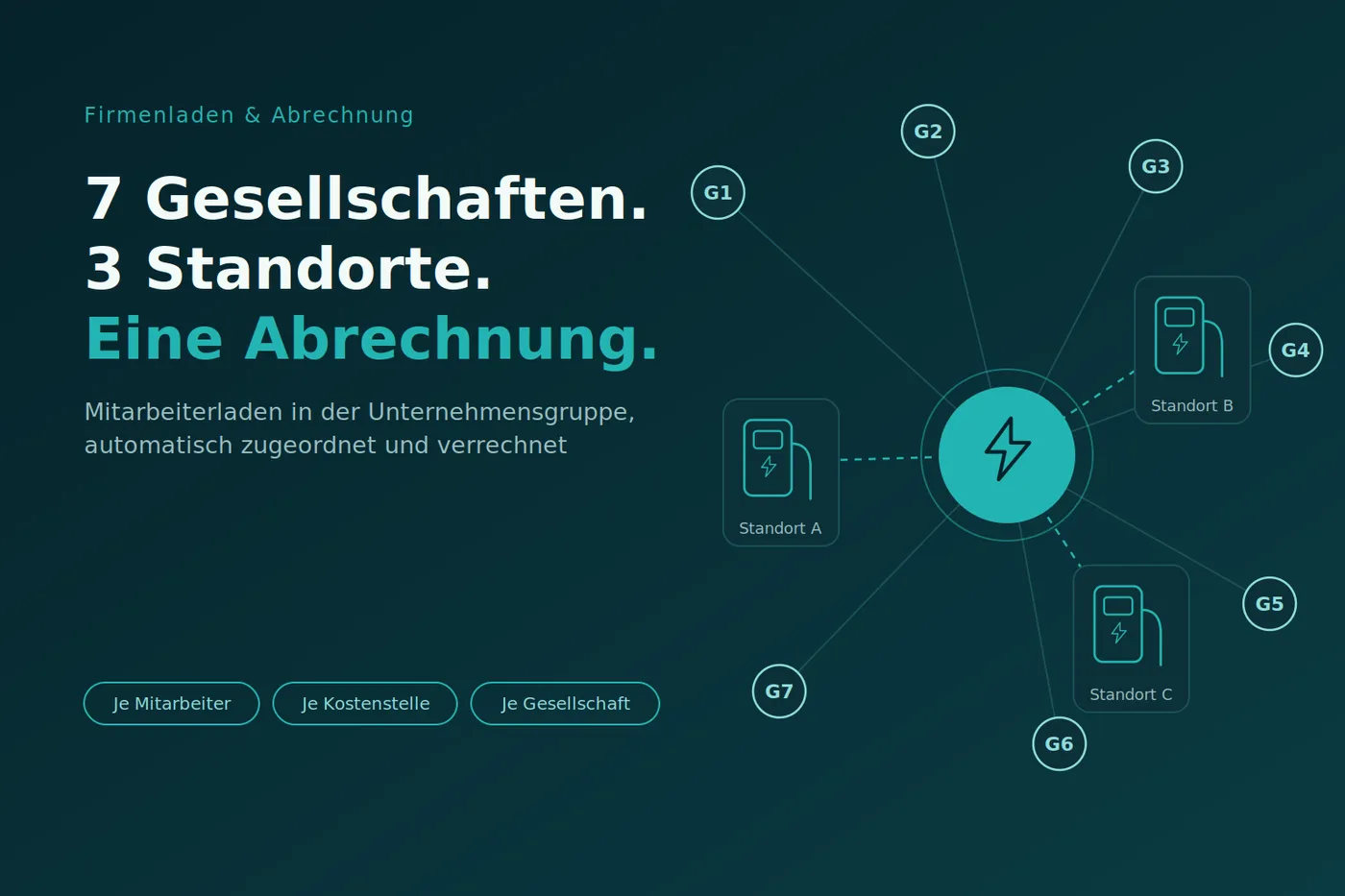
Seven companies, three sites, two electricity buyers. And every employee charges their private EV at work. What sounds like a great benefit quickly becomes a nightmare for accounting. That is exactly how it was for one of our customers, before we set up NeuraCharge Reporting for them. In this article, we show why employee charging gets complicated so quickly in groups of companies, and how billing still works without any manual effort.
The starting point: whoever charges is not whoever buys
In a single company, employee charging is manageable: one company buys the electricity, operates the charge points and bills its own employees. In a group of companies, these roles split apart.
At our customer, it looks like this: two of the seven companies buy electricity, each for different sites. But employees from all seven companies charge at all three sites. Someone working at site A on Monday and at site C on Thursday charges at both locations. In each case, the electricity comes from a different company than the one that employs them.
Three questions at the end of every month
At the end of each month, accounting has to answer three questions, for every single charging session:
Who charged where? Which employee drew how many kilowatt hours at which site?
Who pays what? What amount is due per employee, and which cost centre does it go to?
Who charges whom, and how much? Which company has to recharge which other company, and what amount, for the electricity used?
With seven companies and two buyers, there can be up to twelve intercompany relationships that need clean documentation every month. On top of that come new hires, leavers and cost centre changes.
Why spreadsheets reach their limits
The obvious solution is a spreadsheet: export charging data from the backend, match charging cards to people, people to companies, then split by site and build pivot tables. That works right up until the first charging card changes hands or someone moves to another company and the list is not updated.
Many finance teams know the consequences: hours of manual work every month, back and forth between companies, debates over whose numbers are right and, in the worst case, errors that only surface during an audit.
The solution: every charging session knows where it belongs
NeuraCharge does not start at the end of the month but at the individual charging session. As soon as a person identifies themselves at the charge point, for example with an RFID card, the system automatically assigns the session to:
the right employee,
their cost centre,
their company,
and, via the site, the relevant electricity buyer.
[Insert infographic here: mitarbeiterladen-unternehmensgruppe-infografik.png]
From this data, three reports are created without any manual work:
Billing per employee, regardless of the site where they charged.
Intercompany charging per cost centre, as a verifiable basis for accounting.
Electricity costs per site and buyer, so every purchasing company knows what share of its electricity went into the group's EVs.
Worked example: one month in the group
A simplified example with five of the seven companies shows what the system does in the background. Company 1 buys electricity for sites A and B, company 2 for site C. We assume an internal transfer price of EUR 0.24 per kWh for A and B and EUR 0.26 per kWh for C (example values, net).
Employees of | Site A (kWh) | Site B (kWh) | Site C (kWh) | Charged to company 1 | Charged to company 2 |
|---|---|---|---|---|---|
Company 1 | 600 | 0 | 120 | internal | EUR 31.20 |
Company 2 | 90 | 0 | 400 | EUR 21.60 | internal |
Company 3 | 420 | 0 | 180 | EUR 100.80 | EUR 46.80 |
Company 4 | 0 | 310 | 260 | EUR 74.40 | EUR 67.60 |
Company 5 | 150 | 150 | 0 | EUR 72.00 | EUR 0.00 |
With just five companies and a single month, there are already seven intercompany amounts. Each of them is made up of dozens of charging sessions, which in turn have to be split across individual cost centres. Add all seven companies, cost centre changes and reassigned charging cards, and it becomes clear why a manual approach does not scale. In NeuraCharge, this table is created automatically, including a breakdown down to the individual charging session.
What to clarify before you start
To make automated billing run smoothly, it pays to settle a few points in advance:
Electricity purchasing per site: Which company bears the electricity costs at which site?
Transfer price: At what price per kWh are charges passed between companies, and is a markup required?
Model for employees: Do employees charge for free, at a reduced rate or at full cost? This has tax implications; read more in our article on benefits in kind for electric company cars.
Metering: If you bill per kWh, measurement accuracy matters. You will find background in our article on MID, calibration law and CPMS.
Master data and works council: Employees, cost centres and companies need to be set up correctly once. Since personal charging data is processed, involve data protection and, where applicable, the works council early on.
Connection capacity: When many vehicles charge at the same time, available power quickly becomes a bottleneck. Read how to handle this in our article on limited grid connection capacity.
Employee charging in groups of companies with NeuraCharge
NeuraCharge is a hardware-independent platform for charging infrastructure with a focus on automated, legally compliant billing. For groups of companies, this means:
Every charging session is automatically assigned to employee, cost centre and company.
Billing per employee, intercompany charging per cost centre and electricity costs per site are created without manual work.
All reports can be traced down to the individual charging session, providing a reliable basis for accounting and audits.
Existing charging stations from different manufacturers can be integrated.
The result for our customer: no more spreadsheets, no recalculating and no debates between companies. Do your company cars also charge at home? Then read how to bill home charging of company cars.
Note: This article is for general information only and does not replace tax or legal advice. In particular, the tax treatment of employee charging, appropriate transfer prices between affiliated companies and VAT questions should be clarified with your tax advisor.
Want to bill employee charging across your group of companies automatically? Talk to us about your structure.